Architecture chap book:
Portfolio

Miscellany




In want of a profession. . .
I have for years built this website around my work as a luthier, including pages on what I considered related activities: painting, furniture making, even my travels, with the self-understanding that I was working towards a full-time career in the craft. Meanwhile, my 'day job' in the world of architecture marched silently on and I was happy to keep the two separate. I considered lutherie to be my creative outlet, and for an artist personality that relegated my 'profession' to secondary importance. But my outlook on both pursuits has changed over the years: more experience and self-confidence in architecture has led to more opportunity - more of a voice - for creativity. And as I gain more commissions for instruments I find myself questioning if I really want to make this my only pursuit. Would lutherie loose it's charm if I relied upon it financially?
I am still working through this. But one realization I made is that my website was nearly a complete picture of all my interests and vocations, with one glaring exception: it lacked architecture. First the Heaven's Door project, then the DeGive dulcimer brought home to me that these two pursuits need not be separated. In fact they complement one another.
Here is a sample of my work over the past twenty-five years, now with Keith Summerour, briefly with William T Baker, previously with Summerour and formerly with the firm Jones Pierce, all of Atlanta.

An elevation study for a facade with the geometry of the golden section laid out.

A refinement


Front elevation study of the same Pavillion-scaled house. Sadly the jewel-like skylight was vetoed.

A refinement without the skylight. The volute plinths supporting pots inspired by the violin scroll.

At last I get to build a true wooden timber temple. . .as part of the Pinewood Forrest Poolhouse.

Solid timber architrave, frieze, cornice ! ! !

A study of the front elevation Stoa. And the wrought iron gate.

A small community center we designed for the Pinewood (as it was known until recently) development in Fayetteville, Georgia. It was meant to house mailboxes but also space enough for small gatherings and a pop-up coffee shop. It also has a covered "Stage" which addresses a sloping lawn meant for concerts and craft fairs. Outside extending from one end is a community garden of raised corten planting beds festooned with chimney swifts on long poles. The sidewalls and roof are thatch and the end walls are 'clay' for a Cotswold-by-way-of-Georgia look. Great fun. Sadly, never built. Maybe someday.

The structure was known as "The Hub" because of it's importance in the Community and also because it was to be the site of the wifi structure for the development. So in stark contrast to the Thatch is a perforated metal rhomboid we affectionately referred to as "The Nugget". It would glow at night through its perforated skin, being lit from within. It looks like environmental art but is in fact a cleaver way to conceal a huge conditioned data closet.

The siteplan and ground floor plan showing the community garden and Nugget.

The loft plan, which I thought of as a sort of Medieval musician's Gallery. Appropriate for small wedding receptions.

The front elevation has a be-timbered porch with integrated plank benches for bus waiting. Pinewood is very green and community spirited and public transportation is encouraged. You can catch the bus from your house to the coffee shop to across Highway 17 to the movie studio where you work. This view also shows the "light bars" that we conceived for uplighting the structure. They provide convenient rump rests for additional bus-waiting. Also just visible to the right is "The Nugget"

A section showing the vaulted timberwork and a sort of Musician's Gallery. I was all ready to volunteer to play lute there on the weekends.

Detail showing thatch roof and wall construction. I was inspired to hang modern Edison bulb lights in a 'twinkling star' pattern after hearing the client speak fondly of the Harry Potter experience he visited in Florida. The whole structure has a sort of Hagrid's Cottage feel. Since exposed (or concealed) HVAC ducting was out of the question we conditioned the space from nozzles mounted in eh mezzanine bulkhead. That is, we would have if this was actually ever built.

Section facing the other direction. This section predates the plan above and shows a planked buildout for more storage on the garden-facing end. Hence the air nozzles at the available bulkhead.

The Entry Gate for a Sea Island residence. I created the palmetto leaf as a sort of logo for the property. It was cast in bronze and repeated on the house railings

Self portrait. . .I put myself into the picture as if I were a neighbor paying a visit. It's fun to dream about living on Sea Island. The "Greek wave" motif at the bottom of the gate was a repeating motif used in the stucco work of the main house.

Sea Island Entry Loggia. THe final product wound up being not quite so attenuated with beefier 2/3 Doric columns. We created a 1/4-scale clay maquette for the silver palmetto fronton which was carved in limestone.

Plan and. . .

. . .Building section of the Courtyard. The fountain design features pedal-like seats and scrolls a la the violin.

Detail. We're carrying groceries from the Auto Court.

Sea Island Residence. . .no expense was spared. . .everything from running trim to exterior lighting was custom made. I designed this suite of lights to complement the "Classical Deco" style of the house. These were drawn half full scale across a single vellum so the original is about 5' long.


The grand stair for the Sea Island house terminated in a plaster volute topped by a custom bronze newel post.

A previous study for the same stair

A previous study for the same stair


Two studies for a mantle. I prefered the more-Deco version with the additional radiused protrubence. But the simpler one above is what got built.

This and following a series of renderings I did for a Sea Island Residence. . .


Studying both the scale of the guesthouse lantern and the relationship of the entry door 'shelf' awning to the urn niche. We decided not to go urn but to take the niche to the ground and green it out. And the lantern is too small. The best thing about this drawing is it shows the 'step-step' limestone transom panels found throughout the house. This was a full-on Classical Deco house.

My favorite room in the house is the tall, light-filled breakfast room in the form of a conservatory. This is looking back from that space into the kitchen. All the cabinets were put into plaster niches framed with the cyma shape found throughout the house. To reconcile the crown at the top of the cabinets with this shape I placed bronze wire mesh grilles above the cabinet which makes a dark backdrop for the plaster shape before it. They hide HVAC registers and speakers.

One of many twiggy-planky houses at Blackbrry Farm. This one was published and I was delighted when the decorator thought so much of my stair design that she claimed it as her own. True praise.

Planky. . .

Twiggy. . .


Planketty. . .

Planketty. . .

. . .Plank! This one had a cool method for 'fastening' the timber treads to the stringer, viz a huge staple. That they actually forged many of and embedded just as I drew! Crazy. You never know what's going to make the cut. Also the basement wine room has a planked oculus which you walk over as you go in the front door. Fun.

We were engaged to design a buildout for the top two floors of the Atlanta Mandarin Oriental Buckhead. Figuring out the geometry for an asymmetrical elliptical stair was a fun challenge.

On the back of my Sea Island project it was rewarding to keep the Deco vibe going. It is a favorite style but not one in which I get to often work.

The panels are slabs of bleached wood and backlit and are flanked by fluted limestone or plaster (we had two different color schemes). The panel over the elevator doors is richly veined marble and the coping around the doors is black marble. There are brass fillets laid into the polished plaster soffit. It was a very rich material palette. Sadly, this project was not realized. Had fun drawing it though!


This and following the detailing of a Tudor cottage at Blackberry Farm. I lifted the "blockwork" paneling from a Lutyens interior.


Here's probably my longest drawing. . .this is over 6' long. It's a rambling Tuscan farmhouse that's being built in Odessa, Texas. I only had a day to concept the details for this house that include a formal "high style" house (left) and a more "low style" series of "farm" structures that abut the main house. The formal living room is in the left box. The more relaxed family room is in the central portion with the 2 arched openings. To the right-most part of the drawing I did the interior elevation of the Family Room fireplace elevation. Details below.

A fun detail we're doing lately is to turn the stone flooring material up onto the wall as the first 4" of the wall base (left)


A front elevation study for a house in the Arcadia development outside of Knoxville, TN. Summerour wrote the architectural guidelines for this new township around an 'agrarian' aesthetic so often the homes have barn-like appendages. The 'story' behind this house is an 'original' stone center which was improved over the years as family fortunes increased - adding the refined limestone entrypiece on the otherwise plain stone box, and then adding further dependencies in the form of symmetrical breezeways - later enclosed porches - that connect to garages and further residential wings.

This and following a series of fireplace designs. This in a basement in front of a wine room. The steel doors are in niches beyond timber framed openings.

An Inglenook. I have had the pleasure to draw more than a few Inglenooks while at Summerour. We frequently also detail an accompanying wrought iron firewood rack.

Kind of an unremarkable stone-with-timber arrangement but for the massive 'arch stone' which we will often scrounge from the rural jobsites we inhabit. I also like the 'timber pockets' in the stone reminiscent of the notches left by scaffolding.

A fireplace on a porch which has a limestone surround and a scooped plaster over-mantle to meet the combustible code. Increasing the visual width of the opening are battered corten 'cheeks'. The whole proposition sits on site-reclaimed boulders and a concrete slab which is tooled to blend in with the stone creates a firewood store. Because of the timber truss arrangement and pitched ceiling there is a gap to be filled by the flue which is artistically clad in corten and becomes the flashing which emerges from the roof. Although I am principally concerned with the interior in these drawings I often get to play architect.

This is a fun outdoor kitchen with a pizza oven as well as a conventional built-in grill. Neat details are the corten lining to the firewood niche as well as the warm stained plank inside the stucco niche. Upstairs for reference is the limestone mantelpiece with stone boulders supporting a stone slab raised hearth which made considering the structure necessary.
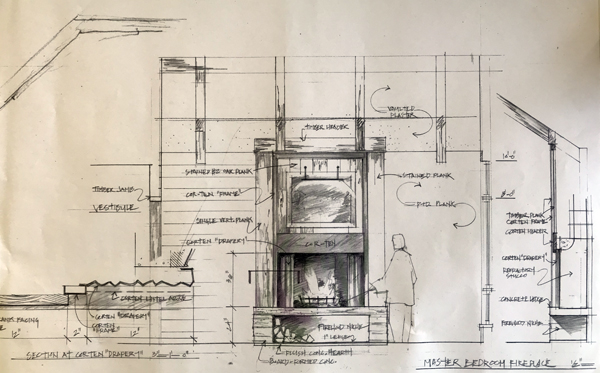
Here's a fun fireplace with a folded corten 'curtain'. The firebox is square but appears much wider as it has folded metal panels 'draped' on either side.

A detail of the 'curtain' shape. I had a long conversation with our metal fabricator about how much detail was possible in a folded corten plate.

Here's another fireplace with a folded corten surround, this time a more conventional ogee shape

A detail of the corten ogee surround

This is a custom cast iron newelpost at the end of a heavy timber stair stringer and sitting on a carved wood tread made to look like a solid cleaved limestone piece. The original concept was for it to actually be limestone but this was considered one-too-many materials. So I wrote the word "wood" on the side of the tread and it became wood. What fun.


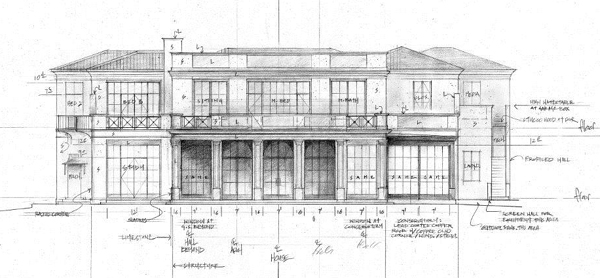
My first project back at Summerour. . .working on a new residence on Sea Island, Georgia. This is an interesting study of the development of the ocean-front elevation over time. We started with a narrower central porch with curved ends and Deco panels at the second level and parapet. But the floorplan changed and the middle drawing shows the new massing trying to hang on to the old styling and porch width. The last drawing is where it landed, with the three-bay massing discarded.

Details for the entry of a Cotswold themed cottage. Complete with Dovecote.


Fun details abound. They actually cast that door knocker.

One detail that I don't think was realized is the clay pot buried in slate chips and piped as a drain under a downspout. Can't have it all. . .

This and following, my work with William T Baker. Here is my first rendering for his design of a home on a wooded site in North Carolina. The perspective is a little contrived as there is a giant shelf of rock protruding out of the ground in the foreground that would obscure the house from this distance.

With Bill Baker. . .A residence we're working on in Alys Beach. First we had lanterns flanking the entry, then they went away because we thought we couldn't have lanterns because of the turtles, then the architectural review board suggested we put lanterns flanking the door. So now we have lanterns.


Two studies of an entry porch for a Shingle-style house. Our client wanted a place for a rocking chair to await the arrival of her children on their weekend visits to this family lakehouse.

A study for a Tudor entrypiece.

A study from our Townhome work in the Serenbe community.

The official marketing rendering showing two of the four proposed buildings.

The development is across form the Serenbe stables so I got to draw a horse.

A rendering from one of Bill's past project photos for a competition entry.

A rendering from one of Bill's past project photos for a competition entry.

A rendering from one of Bill's past project photos for a competition entry.

This and following my previous work with Summerour & Associates. . .I'm really stretching my interior design degree here. A client whose house we designed on St. George Island came back with half an empty city block in Apalachicola looking for ideas for a mixed use infill. The more lightly-drawn buildings on the right-hand side are existing, drawn to scale thanks to Google Street View. I got to take this first pass at coming up with buildings that would have retail on the street with awnings or balconies over the sidewalk and apartments above. Like a lot of historic towns we have a 35' height restriction. These were pretty much my only program guidelines as I came up with a series of buildings that are clad to recreate different historic storefronts. I wanted a rhythm on the street that would be high in the middle and on the ends (mimicking the existing corner structure) and also use the materials to draw the eye down the road to a dark brick end with the lighter materials of painted brick and clapboard, and even corrugated metal on a 'former garage,' at the center. Will this ever be built? How many years down the road? And will it look anything like this? But you can dream with you pencil.

. . . the new development portion. Buildings in the form of (l to r) A Victorian hotel or boarding house with an angled corner, a later 1930s office with an arcade that will get you through to a courtyard addressing the next block, a clapboard general store, and a galvanized garage with two modern storefront entries hidden by 'original' carriage doors. Channeling Walt Disney with my Ouija drafting board. The buildings are divided by the existing 30' lot lines and each has a staircase door to the upper apartments.


This is probably the funnest project I've worked on to date. This is a concept rendering for a distillery perched on a cliff edge with a glass-bottom promontory and a light rail arrival station. Plan below shows relationship to an existing cave which is intended as the retail store. Had to travel to Louisville to tour the still-maker's facility to get equipment dimensions. Moonshine was consumed.

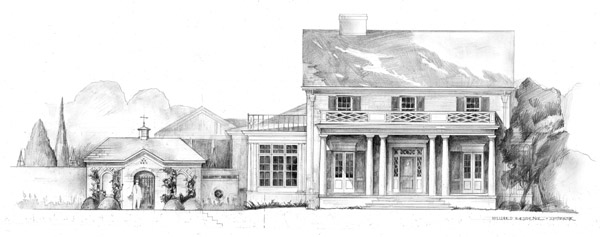
Summerour. . . a rendering of the front elevation of our concept for a renovation. The front porch and garden structure are new.

Summerour. . .a cross section through a screened porch over a loggia. The gal drawn in for scale is mixing a martini. I have noticed in choosing through these sketches that most of the time my figures are doing something with a drink. Hmmm. Also shown are full scale (in the original drawing) profiles of the mantle pieces.

Summerour. . .a conservatory design

Summerour. . .and the details of same. We started with Greek Doric columns, but Keith wanted to stretch the proportions so I chose a Temple of the Winds capital, which is less fussy than a Corinthian. Ultimately I will do a stylization of this to simplify it further.

Summerour. . . my CADD detail sheet of the conservatory above.

Summerour.
. .the front of the house, which shows a Lutyens-esque entry on a Voysey-esque
box. 
Summerour. . .And an enlarged study of the entry with full scale profiles. Leaded glass windows above a limestone door surround.


A couple of details from above: a figure at the front door for scale showing just how big this place is - she's looking for her keys - and the bracket light over the door which I imagined. Will we find something like it? Will it look anything like this when it's installed? I don't get to do much portrait painting anymore so I'm reduced to drawing figures pouring drinks and looking for keys in my architectural drawings.

Summerour. . .This and following are some interior elevations for a modern house with Mediterranean and Alys Beach leanings.

Summerour. . .An upstairs connector hallway off of an entertainment space. Partygoers cocktail -ing.

Summerour. . .A bedroom with furniture ghosted in. This project - like most - has a dedicated interior designer of another firm, but I couldn't help playing decorator. Filling in views with furniture helps present the scale and justify some of the architectural decisions for early meetings.

Summerour. . .Closet, dressing room, shower area and bath area. You can just see our client tying his tie in the mirror. Aromatherapy candle in the tub niche.

Summerour. . .A view of the living room and adjoining loggia with fluted Greek Doric columns. The fireplace design is mine, soon to be vetoed by the designer.

Summerour. . .description to come. . .

Summerour. . .a detail from above, a Deco-inspired fireplace in black marble which has a limestone cove trimming back to the firebox opening.

Summerour. . .an example of rendering frivolity.


Summerour. . Description to come. . .

Summerour. . Description to come. . .

Summerour. . Description to come. . .

Summerour. . .A Beaux Arts-esque study of the entry portico of a massive manor house. Our inspiration came from Lutyen's Gledstone Hall in England. I drew the line drawing with pencil on vellum then copied it on to bond to render the shading with pencil and the background with AD marker.

Summerour. . An interpretation of the plaque from Gledstone Hall

Summerour. . .starting to layout the limestone coursing. The design development for this project was done by hand and I filled in the detail bubbles later in Photoshop.

Summerour. . .companion drawing to above showing the entry steps turning onto the wings.

Summerour. . .a double elevation showing the front of the building from outside and inside of the motor court.

Summerour. . .a side elevation showing just how massive the project is. The connector between the front house and rear block which includes the lantern is actually the sidewall, in the form of an orangerie, of an open courtyard.

Summerour. . .a detail drawing of the side elevation aedicule, including the Doric capital of the porte cochere columns.

Summerour. . An enlargement study of the front portico steps. Note the scale of the figure showing just how massive this is.


Summerour. . .these are two studies for the rear lantern which were not used. Studying whether we wanted to create an open-air experience, where previously the lantern interior was entirely enclosed, conditioned space.

Summerour. . .Switching gears dramatically, Keith got a commission to build an authentic 'Cracker' style cabin on farmland outside of Montgomery, Alabama. I researched the traditional framing methods and generated this building section, pulling out key details.

Summerour. . .from another sheet in the set, showing the framing in detail.

Summerour. . .I don't get to use my makers much when rendering for Keith, so this study for a sporting goods store in Cashiers was a treat.

Summerour. . .the front elevation, showing how we woudl glaze an existing open porch. Note Orvis sign.

Summerour. . .I actually went to our Atlanta Orvis store to measure their fly rod displays.
.jpg)
Summerour. . .a concept for a fabric awning on a wrought iron frame that extends from a loggia over a 'beach entry' pool. The columns are reclaimed wrought iron.
.jpg)
Summerour. . .a building section showing the awning relationship to the pool

The limestone fronton on the front parapet is fleshed out. One improvement sketched in by Keith is the line indicating a scupper, instead of my strip drain. Also my note-to-self to attenuate the whole thing to accommodate a 9' ceiling height beyond.
.jpg)
Summerour. . . the rear elevation showing the awning centered on the main house while the loggia roof continues to the right to compensate for the asymmetrical plan.
.jpg)
Summerour. . . an alternate version with round brick columns supporting a lightly proportioned timber roof structure. In this version, a sloping roof descends from the right-hand wing to 'hide' the asymmetry.

A few weeks down the road the brick column/timber version is approved and I move to the next level of fleshing out. It's very, very lightly constructed. Especially considering i'm wanting to put a clay tile roof on it. Someday - maybe it will be this project - I am going to get to do those round brick columns.

This drawing represents the inevitable step in the design process; value engineering. The above designs show a house that prices out at about 4 million. This wall section, taken at one of the two wings of the house, represents a construction that will price out under 3 million. Goodbye limestone frontons, brick columns and stone cladding. We have more of an Axel Vervoordt barn here, with stained board-on-board plank siding instead of brick (now only at the foundation wall) and chunky timber trim around the windows. And instead of a limestone bedmold, a shaped timber.

This and following, my work with Jones Pierce. This is a lake-front vacation home. . .dimensioned sketches in the primodial phase.


.jpg)
This and following, a study for a series of homes on Lake Martin in Alabama.
.jpg)
.jpg)
.jpg)
.jpg)
.jpg)
I drew this barn for a client retiring to farmland in Missouri. I researched the local forms before spicing it up with modern storefront. The barn was actually a guesthouse. Whether stately or bucolic: the golden section is always there for us. And Thoreau.
.jpg)
Similarly, after completing a facelift on a 1920's cape-cod in the Peidmont Park area, we designed this detached garage with an apartment above with a modern storefront clerestory. Part of a larger sheet that included the siteplan for reference. The brick and the portico were actually repurposed from the original house design.

A rendering from an esquisse to take the client's initial thoughts and determine which massing will best accommodate the program, and therefore what style will be suggested by the massing: here, pointing out specific details and materials that are within the style. The client's obvious desire for a 'showcase home' also helped to steer me towards this Mizner-esque street presentation.

The same house, studied from the rear, showing how to address the steeply sloping property.
.jpg)
A quick signpen study that preceded the above.

Although I have concentrated in recent years on the outside of the house and understanding the heritage of the Southern architectural vernacular, I am by education, and registration, an interior designer, and often get to wear both hats on a project. Here, after establishing the exterior styling and roof massing strategy I am figuring out how it carries into the house. The sunbeam on the right-hand bulkhead is gesturing late-day western sun coming through clerestory windows between the vaulted dining room and a screened porch with open gable timberwork.

A vanity for a master bathroom wanting to project a luxury botique-hotel feel. Notes are for client understanding and contractor pricing effort.

A quick study for a client with an in-town tudor-themed bungalow. Although not in the original scope of work, the client asked my opinion on how to 'spruce up' an existing fireplace that was adjacent to the area of renovation. I was glad to have the opportunity to bring this room further into he theme of the house.

A quick sketch made during a client meeting to flesh out the fireplace design for a Prairie-themed house. The challenge was how to simulate a very expensive detail from the past with a modern square firebox.
.jpg)
Another study some weeks down the road showing the entire elevation with a now simplified firebox. It was part of a renovation that worked with the existing fireplace location, necessitating the asymmetry.

A
virtual teardown in Decatur (Georgia) that allowed a complete re-styling
and re-massing. After vacillating between true English Arts-and-Crafts,
looking much at Lutyens, and a softer cottage vernacular that included
elements of the Georgian, I found this hybrid which speaks more to the
latter. Here my working method is sign pen and AD marker over a CADD wireframe
to facilitate quick changes and variations but to produce a rendering
for maximum client understanding. Sadly, the lot width and client program
pretty much dictated that the garage be on the front elevation, a situation
I try to avoid. It is camouflaged to some degree as a carriage house joined
by a connector. .The same design, rear view.

I have developed a penchant over the years for quickly assessing the strengths and weaknesses of an existing property and translating that into a visual gameplan. Here is an unremarkable, virtually style-less bungalow in the Virginia-Highlands neighborhood of Atlanta which a newly married couple wanted to expand. Due to property and cost restrictions, the obvious choice was to "go up" and not "out", while giving the house a style for the first time in it's 60 year life. I also took the opportunity to "fix" some of the existing mistakes, such as the left-hand three-gang window crowding the front door.

A great property in Highlands, North Carolina set entirely in woodland above a creek. I cannot take credit for the planning, but the massing and cladding strategy issued forth from my current reading at the time: the resort hotels of the White Mountains in New Hampshire. The simplified Edwardian detailing, the mixture of white-painted trim against natural stained wood and the generous use of stone comes together for a very original look. These are also some of my favorite renderings for the playful details. Note wood chopping in progress and fish in the stream.

The same house from the opposite end.

An esquisse to show the client in one panel the first concept for a vacation home. The left-hand showcase garage, though not cantilevered, was inspired by Cameron's house in 'Ferris Bueller's Day Off' The full-height storefront-like glazing opens to create a duel-use pavilion to address a grass-paving terrace. Generally the style for this house is what I call 'New Venetian'.

An in-town 'facelift' project. This house was featured on HGTV's 'Groundbreaker's' where I had my 15 minutes of fame. Actually my air time boils down to about 5 minutes. Another favorite rendering, for the details. This particular drawing was actually never meant to see the light of day: intended really for personal consumption. I have started with an as-built CADD wireframe which I have whited out and boldly markered over those elements to be demolished.

What drives a good design for me is right from the start identifying ideas that exploit the natural characteristics of the site. In this example, the site is long and has a grade change from side-to-side. I knew that the program would include a pool and formal and informal gardens. Idea #6 is "Drive Below the House", meaning that the access from the front formal entry to the side secondary or 'service' entry could be on a grade lower than the main terrace on which the house is built. This reduces the intrusion of the automobile into the landscape, creates a breathing space between the house and the side road, and works with the natural topography to reduce grading and impact to the natural balance of the site. Idea #10 is "Folly As Anchor". The use of a gazebo or garden shed disguised as a small cottage is a classic architectural device to define space, to provide focal point, and to strengthen an axis. Due to the great length of the site and the alignment of garden, house, and lawn, this is especially effective. Also in this earliest sketch stage we see the overlaying of the sun angles.

A typical intermediate sketch between the rough siteplan above and the rendering below, working out in more detail what the 'ideas' look like before going to a dimensioned drawing. Here we're adding a screened porch to the rear of a Virginia-Highlands bungalow.

A siteplan, rendered to help the client understand how I wanted to use planting schemes to contribute to the Arts-and-Crafts world we were creating in the house.

The same project, now morphed into a more Prairie-themed house with the carport relocated to the side. Goodbye beautiful Gertrude Jekyll garden.

One of many elevation studies for a home in the Brookwood Hills Golf Club of North Atlanta. I'm exploring with the client just how authentically 18th century we want to be. Again, employing the sign-pen-and-marker-over-CADD wireframe method to create many accurate yet "liquid" studies.
.jpg)
A sheet of construction details from the same project.

This is an interesting drawing I did in the primordial stage of the project to zero in on a style. What it turned into was the development of a "story" for the house. The remit from the client was to "build a house that feels as if it has been there for 200 years." This for one helped establish the colonial plantation aesthetic or "Picturesque Colonial" which is represented just left of center. Other styles were investigated as regionally, historically and geographically viable (Formal Georgian, Arcadian because the clients were from Louisiana) or soundly rejected (Queen Anne, Italianate being too "late"). The feeling of the house was achieved through the telling of a family which built a home on what was then the Georgia frontier, circa 1805, and the house growing with the family over the centuries: A detached summer kitchen was assumed into the body of the house yet retained its brick "cooking wall", A detached stable became connected to the house in the 1920's with the arrival of the automobile, etc. The following is my project description for marketing purposes:
The Coffman Residence: A Tale of Acadie
A Southern Colonial themed home created with a unique thought process. Building on a 2-lot site overlooking the Brookhaven Country Club golf course, our clients wished foremost to capture a bit of their native Louisiana. What would unfold over a year-long planning process was a home that projected the timeless authenticity of deep south architecture yet would incorporate in the most unobtrusive way the most up-to-the-minute sustainable building technology. The key to the former was the writing of "the Story of the House."
In the past centuries, rural homes of southern America, from modest structures to grand mansions were often designed not by an a trained architect, but by a master builder who relied on architectural style guides, showing the practical application of the Orders of the Classical Period and other useful geometry and detailing. The eventual prevalence of these structures formed our national subconscious for architectural good-taste and the effects are still felt today when we react positively to homes with good proportions, symmetry, and elegant simplicity. So to create a home with a sense of historic permanence we retraced the imagined steps of a simple plantation house, built in what was "then" rural Georgia in the early-to-mid 19th century: added onto in logical ways by a growing family and inheritance, and modernized right up into the 20th century with the conversion of the now-attached stable to embrace the automobile. The effectiveness of this method is proved at every turn: one experiences the symmetrical formality of the front house which gradually relaxes, passing through a brick-lined kitchen which at one time may have been detached for very practical purposes, finally arriving full circle at a colonial-themed three-season screened porch inspired by the rebirth of Williamsberg in the 1930's. Porches were added and expanded, formerly exterior brick paving and clapboard walls became enclosed by window-lined connectors: each space has a chapter to tell in the Story.
Sustainability has come to mean in recent years tankless hot waterheaters, geothermal heating, radiant floor heating, "smart lighting" controls - all devices used in this house - but more compelling is the rediscovery of the old ways and materials that made living in the humid south a little more bearable: the second level sleeping porch, composed on an east-west axis for maximum performance; the arrangement of overhangs and loggias to protect southern exposure. Rainchains can direct water to an underground cistern and light-absorbing paving is used inside and out to absorb heat by day and radiate out by night. Authentic materials are used where they have the greatest "touch", such as smooth wood-molded bricks and saw-hewn cypress timbers, and the solid slabs of granite that welcome guests to the front door. Whereas only successful modern facsimiles are used where superior maintenance properties or cost effectiveness makes them indispensable, such as simulated slate roofing and wood-free trim in hard-to-paint roof dormers. Thus altogether making a modern home with charm and permanence: a Lifetime Home.
Further
Reading:
Longfellow's Classic
poem
An
historic facsimile style guide

This is a project which won the Atlanta Urban Design Commission's 2009 award for preservation. A house dating from the early days of the Inman Park neighborhood, we removed a pooly-concieved 1980's- vintage rear addition and built back an historically-themed kitchen and master suite while supervising the preservation of the existing front-of-house spaces. Finished photography by Lee Grider.

The original, pyramidal roof of the main front house is visible here beyond the wacky '80's addition. This was an obvious choice of roof solution for the rebuild which you see duplicated in the 'After' picture above. Following are some images of the excellent original features that were preserved.
.jpg)
.jpg)
.jpg)
.jpg)
.jpg)
.jpg)
.jpg)

The house was featured on the 2009 Inman Park tour of homes, and I prepared this write-up as a hand-out. It was also my prospectus for the winning UDC award submission:
""The Beautiful Home of Hon. H. E. W. Palmer For Sale!…a seven room, furnace heated Cottage and Servants House…has all conveniences; sewer, water, gas, electric lights, tile sidewalks, and the choicest neighborhood to be found."
This heading from a 1909 realtor's advertisement excitedly touts the conveniences to be found in Atlanta's first planned community and goes on to describe the benefits of living "on the North Side where everything is charming and delightful." The house at 463 Sinclair Avenue (formerly 155, Atlanta renumbered all its streets in the mid 1920's), however, was a witness to the neighborhood which would grow around it. The house is known to predate the 1889 land auction held by entrepreneur Joel Hurt, giving it the distinction of being perhaps the oldest home in what is now defined as Inman Park. It was a farmhouse, built by Palmer on land purchased in 1886 from Sarah Colquitt, wife of Governor A. E. Colquitt. After the 1909 sale Palmer would build the house at 482 Seminole, his residence at the time of his death in 1921.
At the time of the recent renovation, the house had come down to us with surprisingly few alterations and much of its original character. New owners Lee and Susan Winton, in consultation with architects Jones Pierce, implemented a significant rear addition and the meticulous restoration that the house deserved. When purchased by the Wintons in 2005 the house was affected with a dated rear kitchen addition. The primary concern was to build a more historically sensitive expansion which would now include a master suite. The unique pyramidal roof of the main home's original design was duplicated over the addition, unifying new kitchen and bedroom with a characteristic sleeping porch facing the rear.
Visitors are greeted by a glorious Edwardian flamed oak double front door. The characteristic vestibule contains a period art-glass pendant. The leaded glass transom is a story unto itself. The ribbed glass pieces of the original transom combined with colored pieces of antique church glass were assembled into a new design by a cousin of the present owner. A curiosity is the hidden compartment in the side of the front parlor fireplace paneling, lined with century-old wallpaper. Many of the lighting fixtures, although not authenticated to Palmer's ownership, are from an era when electricity was treated with suspicion. Two fixtures are of the gas and electric combination, now converted to be fully electric. Perhaps the most impressive fixture which dates from this period is the adjustable-height electric chandelier in the dining room. The original pine doors come down to us intact through the forethought of previous owners who stored the doors for future restoration. The front-house coal-burning fireboxes, mantles and glazed tile surrounds are intact.
Transitioning from preservation/refurbishment to modern addition through the original connecting hallway, new oak strip flooring changes in a closet to reveal the original pine plank flooring underneath. Also in the hallway, a refurbished bathroom has original cast brass transom window hardware which was relocated here from a bedroom. The new master suite shows window and door trim custom made to match the homes' original trim. Modern fixtures and appliances we selected for their ability to blend gently into the historical setting. An automated screen at the sleeping porch disappears when not in use. Duel vanities in the master bath are separated by a tall island of millwork reminiscent of Victorian museum displays. A new fireplace reflects of the originals and the oak paneled mantle conceals a flat screen television. Susan, a multi-media artist specializing in ceramics, created the beautiful glazed tiles set into the hearth.
The house is a testament that through the stewardship of appreciative owners, historically significant structures can continue to be comfortable family homes in the modern age with sensible remodeling and informed preservation."
++++++
Architecture Field Trip.
Tireless scholarship in the library and countless hours at the drafting table are good ingredients for the well heeled architect, but sometimes you just have bust out and get some air in your lungs with the real thing. I have made seeking out and studying the local architecture a priority on my vacation destinations for years (some of which is referenced on my Travels page) but have in the past couple of years begun, with my wife, a fellow old-building lover, to make forays into our more immediate Southeast to better understand the Southern Classical Heritage. The following are a few recent excursions. Enjoy.
Hills and Dales House, LaGrange, Georgia. Can't believe J Neel Reid was only 29 years old when he designed this house for the Callaway Family.


A study of the portico
.jpg)
.jpg)
The plaque over the front door and one of the interior elevation drawings on display in the visitor's center.
.jpg)
.jpg)
A couple of standout details: the elegant scrolls supporting the rear casement window ledge and the integral gutter of the main roof as viewed from the attic billiards room
.jpg)
.jpg)
A couple of distance shots of the rear
.jpg)
.jpg)
In the garden behind the house were numerous follies, including a well with ironwork designed by the architect and a series of statuary. Reminding us of the importance of frivolity.
.jpg)
.jpg)
An alle and a box parterre. Pea gravel contained by granite steps and curbing seals the 17th C European deal.
.jpg)
.jpg)
A smart little greenhouse terminates one end of the garden. The garden is all about controlled views. This peek at the house is from the Callaway's favorite vantage point: the semi-circular gryphon-adorned bench across a small pond. It was their special place to take coffee in the morning.
.jpg)
.jpg)
Though not part of the original design, this poolhouse was a sympathetic Mediterranean effort.
.jpg)

A rear facade close-up and the fountain directly opposite.
++++++
Ansley Park J Neel Reid Tour of Homes, 2010. On the heels of our visit to LaGrange to see the Neel Reid Callaway House we got in on this well-organized stomp around Ansley to see all things Reed in "Atlanta's First Neighborhood." It was an eyeopener considering my many years of working in this neighborhood, blissfully unaware that some of my favorite homes were in fact the work of Atlanta's favorite architectural Son.
.jpg)
.jpg)
218 Fifteenth Street. c. 1911 in the American Georgian style. I have summoned images of this house to illustrate the Beaux Arts-inspired use of the belt course, unusual in a clapboard example, as well as for the "plaques" above the main windows.

.jpg)
One South Prado Condominium, The Della Manta, Unit #3 once owned by Margaret Mitchell.
.jpg)
.jpg)
262 The Prado, c. 1910 Tudor adaptation. The broad face of the house overlooks a parking court which gives breathing space on what appeared to be the south side, thus capitalizing on sunlight.
.jpg)
.jpg)
Reid House Condominium, c. 1923-1924 Georgian Classical design. Originally called the Garrison Apartments. We toured a unit which has been owned for the past 30+ years by a much traveled, art collecting, bibliophile lawyer, which made prohibition against photography inside the unit quite distressing, as the entire space was a homage to decadent upper-class bachelor living. Sympathetically decorated by interior designer David Byers. Thomas Crown would have approved.
.jpg)
.jpg)
109 Peachtree Circle c. 1921. Has a new-classical federal feel. This house was particularly light and airy and well connected-to-the-outside-feeling as one passed through the three front interconnected rooms.
.jpg)
.jpg)
17 Inman Circle. c. 1915 in the Colonial Revival style" in the Jeffersonian manner."
.jpg)
.jpg)
In some of the homes we were permitted to take interior shots. Here's a great Adams fanlight with curiously changing geometry at an interior portal. This house felt particularly old-Atlanta in its decoration. Dude, you wouldn't get out of my shot so now you're preserved for posterity on my website. Hope you liked your haircut that day!
.jpg)
.jpg)
230 The Prado c. 1913 "Dutch Colonial". I was surprised to see Reid step so far outside the box of classical detailing. This house has a Voysey-esque sense of playfulness, with over-scale columns with no lintel and out-of-scale, structurally pointless brackets. I felt for a moment as if I was back in Portmerion. Some of the homeowners on the tour had copies of the original drawings. Yep, that's what he really did!
.jpg)
.jpg)
The whimsy just kept on giving with the rear house having gothic and tudor undertones. The kitchen was interesting for being both the original size and (seemingly) configuration yet subtly updated with modern antique-feeling appliances and thereby retaining the period vibe.
.jpg)
.jpg)
Not to be outdone in the whimsy department, the tour continued out the back and up a well-gardened hill to a folly, viz the potting shed. One could even get behind and above the building on a rear alley and overlook the whole kingdom of Whimsy.
.jpg)
.jpg)
Gardener's delight.
.jpg)
.jpg)
Really liked the folly.

.jpg)
132 Peachtree Circle c. 1911 A Georgian Italianate Revival. Surrounded by a brick lattice wall and an English garden. What would entice people to wait in a line this long on a hot summer day? Must be pretty good inside.
.jpg)
.jpg)
Classic detailing. I was told that this fireplace was not original to the Neel Reid design, but it was impressive nonetheless. Good Adams detailing. An inspiration.
.jpg)
.jpg)
Outside and in of the Palladian casement windows.
++++++
St Genevieve, Missouri. On our big Road Trip '09, Shannon and I spent the better part of a day rambling around this historic French Colonial town.


The Jean Baptiste Ste. Gemme Beauvais House, 1792. a French creole vernacular post in ground (poteaux-enterre) construction. Its cedar log walls are set directly into the earth, without a foundation. The roof system consists of king-post trusses and longitudinal wind braces.


.jpg)
.jpg)

.jpg)
The Jean Baptiste Bequette House built over-looking the Le Grand Champ agricultural fields c1780s. And a look under the porch.


While exploring this house we came across real Historic Preservation students in their natural habitat. These guys from the local university are repairing the parging. Which not suprisingly has a tendancy to fall off of timber-framed walls. Note stakings placed by the other group college students working at this site: the archeologists.


Great mortise and tenon joinery at the porch structure. Since my timberframing workshop I have a new appreciation for the amount of effort that goes into making a round tree square.


Note that they only squared what they needed to. The footing portion of this porch post was left in log-form.
.jpg)
.jpg)
The Bolduc House was the first authentically restored historic structure in St Genevieve. It was built in 1770 out near the river on the Le Grand Champ field by Louis Bolduc, a Canadian lead miner, merchant and planter. The house is of vertical log construction but is a post on solle or foundation. The stockade fence says "keep out". After the "great flood of 1783" the house was taken apart, and reassembled in its present location in 1784.
.jpg)
.jpg)
The Rene LeMeilleur House, first built in 1820 of heavy-timber frame construction. Old photos show that this house was once a two-story, frame I-house. Nearby is the Jacob Philipson House, a one and one-half story, side gable, limestone dwelling planned as both a merchant store and family quarters.
.jpg)
.jpg)
Nearby is the Jean Baptiste Valle House, also known as The Commandant's House. I wonder if the cellar stays dry under that porch.
.jpg)
.jpg)
There were several other structures of note that dated well after the French colonial period that caught our eye. This shingle-on-celler house is now a bed and breakfast. And a charming little shop with Thomas Kinkade-like luminesence. Combining three of our favorite things: Antiques, icecream, period architecture.
.jpg)
.jpg)
And when visiting beautiful St Genevieve, be sure to see. . .the industrial wasteland next door ! ! !
++++++
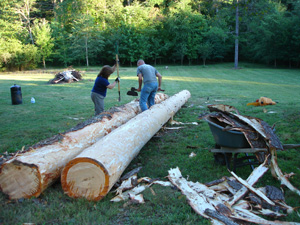
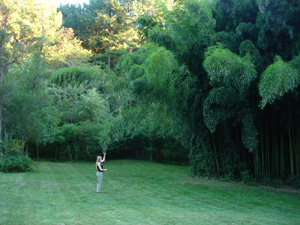
Timberframing in Brasstown, North Carolina. Earlier this year (September, 2010) Shannon and I volunteered to help Jayson Wilson and a small crew begin a barn on a beautiful property outside of Brasstown, near the John C Campbell Folk School. The bamboo grove was incredible. I spent most of the time peeling bark, but got in a little time on the broad ax for hewing. Following are some images of the early work, working on the two principal beams. This is an ongoing project and we're headed back up there in November for the raising.
.jpg)
.jpg)
This is such a momentous and unending experience that I have created it's own page here.
++++++
Stone Mountain Village, Georgia. Best not to overlook the architectural treasures in your own back yard. I have memories of the village in the shadow of the mountain from my early childhood in the 1970's. On Christmas visits to Georgia in the '80's and during my college and early professional life in the '90's I would see it grow and shrink and grow again. Currently (2011) I believe the village is seeing a rebirth, with the removal (and hopeful historically sensitive replacement) of the storefront awnings, the addition of a traffic-calming median on Main Street, and the slight but noticeable influx of new businesses. It wasn't until last year, though, that I started my own photo documentation. Wish I had pictures from it's 'heyday' of the early 1990's! The following is a sophomore effort. I hope this will turn into a full documentation of the architecture of a classic deep south railroad town.
.jpg)
.jpg)
This is a before and after photo. Alot of homes are vacated by families that owned them for decades and fall into disrepair. This one however was renovated last year (2011) by descendants of the previous owner. Following pictures taken as the renovation was beginning.
.jpg)
.jpg)
.jpg)
.jpg)
.jpg)
.jpg)
.jpg)
This is my favorite house in the village.
.jpg)
.jpg)
.jpg)
.jpg)
.jpg)
.jpg)
Another before and after. This building has fond memories for me as a toy shop when I was a kid in the 80's. It stood empty for many years and is now a restaurant.
.jpg)
.jpg)
Yes, that is a squirrel on that brick wall. Squirrels own this town. And bees.
.jpg)
.jpg)
.jpg)
.jpg)
Great sunset over the gazebo on Main Street.
.jpg)
.jpg)
Lots of Stone Mountain granite in Stone Mountain Village.
.jpg)
The old train station is now town hall. The train still goes by every couple of hours.
.jpg)
.jpg)
The sad fate of many charming homes in the village.
The following images document the demolition of an early 19th c. log cabin that stood for decades behind the streetfront buildings, at the end of a long alley. When I was in college in the early 90's this was the home of 'Stones' a local bead and handmade jewelry shop. It then turned to an 'antique' store then stood empty for years until being bought by a richy-rich from North Carolina where it will be reassembled log by log and become an estate guest house. At least it was saved. Sorry to see it leave us.
.jpg)
.jpg)
.jpg)
I came across this activity completely by chance. They had the roof off already.
.jpg)
.jpg)
.jpg)
.jpg)
.jpg)
.jpg)
.jpg)
.jpg)
.jpg)
I got to take this tin chandelier home with me. It now has pride of place in my workshop.
.jpg)
.jpg)
Lots of dendritus from he previous occupants. Lord only knows how old this stuff is. The bottles look like moonshine, but I think it was actually really old photo developer.
.jpg)
.jpg)
.jpg)
.jpg)
Shannon examines some of the fire sale items.
Of course you can't talk about the village without looking at the mountain too. Descriptions to come . . .
.jpg)
.jpg)
.jpg)
.jpg)
.jpg)
.jpg)
.jpg)
.jpg)
.jpg)
.jpg)
.jpg)
.jpg)
. . .More to Come. . .
++++++
Book List.
The best explanation of my areas of interest and expertise can be found in a catalog of my architecture library. The first book on architecture I obtained was the HOK book, when I was 11. This will be an ongoing project for me as I move steadily through every room in the house. This is, at this time, a quite incomplete list. Enjoy.
Drawing//
The Power of Limits: Proportional Harmonies in Nature, Art and Architecture/
G Doczi/Shambhala 1994
Cyclopedia of Drawing /American School of Correspondence 1905
Illustration Guide /L Evans /Van Nostrand Reinhold Co 1982
*Masterpieces of Architectural Drawing /H Powell /Abbeville Press 1982
The Principles of Architectural Drafting /HC Browning /Whitney Library
of Design 1996
Sketching the Concept /H Linton /Design Press McGraw Hill 1993
Professional
Practice// including graphic standards, code books, manuals, etc
Specifications for Commercial Interiors /SC Reznikoff /Whitney Lib of
Design 1989
ASID Professional Practice manual /JA Thompson /Whitney Lib of Design
1992
Professional Practice: A Handbook for Interior Designers /RM Veitch /Peguis
Publishers 1990
Architectural Woodwork Quality Standards 7the Ed /Architectural Woodwork
Institute 1997
Interior Graphic and Design Standards /SC Reznikoff /Whitney Library of
Design 1986
Architectural Drafting and Design /A Jefferis /Delmar Publishers Inc 1986
Materials and Components of Interior Architecture 4th Ed /JR Riggs /Prentice
Hall 1996
The Second Old House Catalogue /L Groa /Bonanza Books 1982
Modern//
Bauhaus to present but excludes Japanese architects
The Dessau Bauhaus Building 1926-1999 /M Kentgens-Craig /Birkhauser 1998
Renzo Piano's Village for the Arts/ High Museum of Art 2005
The Bauhaus: Masters and Students/ M Droste/Barry Friedman Ltd 1988
The Kimble Art Museum /M Brawne /Phaidon Architecture in Detail1992
Bauhaus Dessau /D Sharp / Phaidon Architecture in Detail1992
Classical Modern Architecture /A Papadakis /Terrail 1997
Bauhaus /HM Wingler /MIT Press 1986
Dallas Architecture 1936-1986 /D Dillon /Texas Monthly Press 1985
Ludwig Mies van Der Rohe Furniture and Drawings from the Design Collection
/L Glaeser /MOMA 1977
Marcel Breuer: Furniture and interiors /C Wilk /MOMA 1981
Walter Gropius /Sigfried Giedion /Dover 1992
Gropius /R Isaacs /Bullfinch Press 1984
Louis I Kahn: In the Realm of Architecture /DB Brownlee /Rizzoli 1991
Architecture in the Real World : The Work of HOK /W McQuade /Abrams 1984
Bauhaus: Bauhaus Archiv /M Droste /Benedikt Taschen 1990
The New Architecture and the Bauhaus /W Gropius /MIT Press 1965
Architecture and Utopia: Design and Capitalist Development /M Tafuri /MIT
Press 1992
Towards a New Architecture /Le Corbusier /Dover 1986
Architects of Fortune: Mies van der Rohe and the Third Reich /ES Hochman
/Weidenfeld Nicolson 1989
Deconstructing the Kimbell /M Benedikt /Sites Books 1991
New Wood Architecture /R Slavid /Yale University Press 2005
Bauhaus and Bauhaus People revised edition/E Neumann /Van Nostrand 1993
Alvar Aalto: Points of Contact /M Lahti /Alvar Aalto Museum 1994
A Garden for Art: Outdoor Sculpture at the Hirshorn Museum /VJ Fletcher
/Thames and Hudson 1998
Designing Disney's Theme Parks /KA Marling /Flammarion 1997
Spanish Design and Architecture /ED Coad /Rizzoli 1990
Twentieth-Century Houses: Architecture 3's /B Dunlop /Phaidon 1999
Japanese
Modern//
Japan Design /M Dietz /Taschen 1992
Contemporary Japanese Architects /D Meyhofer /Taschen 1993
The Architecture of Hiromi Fujii /K Frampton /Rizzoli 1987
Toyo Ito: Architectural Monographs No 41 /C Jencks /Academy Editions 1995
The Japan Guide /B Bognar /Princeton 1995
Classic// all pre-enlightenment Europe
The Ten Books on Architecture /Vitruvius /Dover 1960
Early Medieval Architecture /R Stalley /Oxford 1999
Hadrian's Villa Guide /B Adembri /Electa 2000
The Architecture of the Renaissance in Italy /WJ Anderson /BT Hatsford
1909
Architecture of Rome /GB Cipriani /Rizzoli 1986
*Manor Houses in Normandy /Y Lescroart /Konemann 1997
*The Elements of Architecture /Henry Wotton /Longmans Green & Co 1624
Colonial//
includes all pre-industrial America
Architecture of the Old South: Maryland/ M Lane/ Abbeville Press 1991
Colonial Interiors: Federal and Greek Revival /HD Eberlein /Bonanza Books1938
Williamsburg Reproductions: Interior Designs for Today's Living /Craft
house 1967
Colonial Williamsburg Decorates for Christmas /LH Oliver /CW Foundation
1981
Early Domestic Architecture of Connecticut /JF Kelly /Dover 1963
Country Style /G Knox / Better Homes and Gardens 1987
Colonial Craftsmen /E Tunis /Johns Hopkins 1999
Visiting Our Past: America's Historylands /D Boorstin /National Geographic
1986
An Eighteenth-Century Garland /L Fisher /Colonial Williamsburg 1951
The Farm on the Gravois: Historic Structures Report /AW O'Bright /US Grant
Nat Hist Site 1999
Thomas Jefferson's Monticello /RC Lautman /Monacelli Press 1997
Architects of Charleston /BS Ravenel /Univ of S Carolina Press 1992
Carolina Plantations /WP Baldwin /History Press 2007
The Architectural Treasures of Early America I: Survey of Early American
Design /LC Mullins /Nat Hist Soc 1987
The Architectural Treasures of Early America II: Early Architecture of
the South /ibid
The Architectural Treasures of Early America III: New England by the Sea
/ibid
The Architectural Treasures of Early America IV: SColonial Architecture
of the Mid -Atlantic /ibid
The Architectural Treasures of Early America V: The Homes of New York
and Connecticut /ibid
The Architectural Treasures of Early America VI: Early Architecture of
Rhode Island /ibid
The Architectural Treasures of Early America VII: Village Architecture
of Early New England /ibid
The Architectural Treasures of Early America VIII: Early American Southern
Homes /ibid
The Architectural Treasures of Early America IX: The Evolution of Colonial
Architecture /ibid
The Architectural Treasures of Early America X: Early American Community
Structures /ibid
The
Architectural Treasures of Early America XI: Blueprints for America's
Past /ibid
The Architectural Treasures of Early America XII: The Southern Tradition
/ibid
The Architectural Treasures of Early America XIII: Styles of the Emerging
Nation /ibid
The Architectural Treasures of Early America XIV: The Grandeur of the
South /ibid
The Architectural Treasures of Early America XV: The Georgian Heritage
/ibid
The Architectural Treasures of Early America XVI: Spirit of New England
/ibid
Roots of Home: Our Journey to a New Old House /R Versaci /Taunton Press
2008
Williamsburg Before and After /GH Yetter /Colonial Williamsburg Foundation
1988
*Classic Savannah /WR Mitchell /Golden Coast 1991
A Window on Williamsburg /JJ Walklet /Colonial Williamsburg Foundation
1983
Recreating the Historic house Interior /W Seale /American Assoc for State
and Local Hist 1979
Williamsburg: Decorating with Style /T Foley /Clarkson Potter Publishers
1998
Official Guide to Colonial Williamsburg /M Olmert /Colonial Williamsburg
Foundation 1989
Historic Charleston /S Abbott /Oxmoor House 1988
Historic Houses Restored and Preserved /M Page /Whitney Library of Design
1981
The Modern Carpenter Joiner and Cabinet-Maker: Legacy of Wood & Woodwodking
/GL Sutcliffe /The National His Soc 1990
The Modern Carpenter Joiner and Cabinet-Maker: Survey of Carpentry Masterpieces
/ibid
The Modern Carpenter Joiner and Cabinet-Maker: Craft of Case-Making and
Cabinet-Making /ibid
The Modern Carpenter Joiner and Cabinet-Maker: Heritage of Styles and
Essential Woods /ibid
The Modern Carpenter Joiner and Cabinet-Maker: Mastery of Joinery &
Business /ibid
The Modern Carpenter Joiner and Cabinet-Maker: Tradition of Wood-carving
& Stair-Building /ibid
The Modern Carpenter Joiner and Cabinet-Maker: Compendium of Drawing &
Drawing Instruments /ibid
Old Virginia Houses Along the James /EF Farrar /Bonanza Books 1957
Early American Architecture /H Morrison /Dover Books 1987
The Colonial Architecture of Salem /F Cousins /Dover Books 2000
A Guide to Early American Homes: North and South /D Pratt /Bonanza Books
1956
Gibb's Book of Architecture /J Gibbs /Dover 2008
The Country Builder's Assistant /A Benjamin /Applewood Books 1992
Under the Oaks: The Last Great Houses of the Old South /C Seebohm /Clarkson
Potter /2002
Arts
and Crafts// includes English and American
Arts and Crafts Archtiecture /P Davey /Phaidon 1997
The Bungalow: America's Arts & Crafts Home /P Duchscherer /Penguin
Studio 1995
Inside the Bungalow: America's Arts & Crafts Interior /P Duchscherer
/Penguin Studio 1997
*The New Cottage Home /J Tolpin /Taunton 1998
Craftsman Homes /G Stickley /The Lyons Press 2002
The Arts and Crafts Movement in America 1876-1916 /RJ Clark Ed. /Princeton
Univ Press 1992
Arts and Crafts Masterpieces: Architecture 3's /B Dunlop /Phaidon 1999
Arts and Crafts Houses I: Architecture 3's /B Dunlop /Phaidon 1999
Arts and Crafts Houses II: Architecture 3's /B Dunlop /Phaidon 1999
Arts & Crafts Ideals: Wisdom from the Arts & Crafts movement in
America /B Smith /Gibbs Smith 1999
Monographs//excludes
Japanese architects, Modernists and Frank Lloyd Wright
Bernard Maybeck: Visionary Architect /SB Woodbridge /Abbeville Press 1992
William L Price/ G. Thomas /Princeton Architectural Press 2000
*James Russell Pope /J Garrison /Acanthus Press 2004
*John F Staub /S Fox /Texas A&M University Press 2007
The Leisure Architecture of Wayne McAllister /C Nichols /Gibbs Smith Press
2007
The Idea of Louis Sullivan /J Szarkowski /Bulfinch Press 2000
The Essential William Morris /I Zaczek /Parragon 1999
Lewis Edmund Crook Hr, Architect /W Mitchell /The History Business 1984
The Home Within Us /B McAlpine /Rizzoli 2010
Frank
Lloyd Wright//
The Decorative Designs of FL Wright Renwick Gallery Exhibit Guide /D Hanks
/ US Gov Printing Office 1977
Frank Lloyd Wright: Prairie houses /A Hess /Rizzoli 2006
Frank Lloyd Wright: Architecture 3's /B Dunlop Ed. /Phaidon 1999
Taliesin West: An Interpretive Guide /SA Lucas /Frank Lloyd Wright Foundation
1993
Frank Lloyd Wright: Letters to Clients /BB Pfeiffer /California State
Univ 1986
At Taliesin: Newspaper Columns by FL Wright and the Taliesin Fellowship
/RC Henning /FLW Found. 1992
Understanding Frank Lloyd Wright's Architecture /D Hoffmann /Dover 1995
Frank Lloyd Wright's Rosenbaum House: The Birth and Rebirth /BK Broach
/Pomegranate 2006
English//
pre-Victorian and includes all Britannica
Regency Style /S Parissien /Phaidon1996
The English Room /C Irvine /Bulfinch 2001
English Style /S Slesin /Clarkson Potter Inc 1984
Understanding Small Period Houses /A Laws /Crowood Press 2003
Tudor and Jacobean Country House /M Airs /Bramley Books 1998
A Companion to the English Parrish Church /S Friar /SuttonPublishing 1996
*In the Houses of Ireland /W Pfeiffer /Stewart Tabori Chang Inc 1988
Neoclassicism and Romanticism /R Toman /Konemann 2000
A Cotswold Village /JA Gibbs /Alan Sutton 1998
A Country House Companion /M Girouard /Yale University Press 1987
*Cotswold Gardens /D Hicks /Weidenfeld & Nicolson 1995
English Historic Carpentry /CA Hewett /Linden Publishing 1997
Castles In Ireland: Feudal Power in a Gaelic World /T McNeill /Routledge
1997
The English House /J Chambers /Methuen London /1985
Victorian//
England and elsewhere
Victorian and Edwardian Décor: From the Gothic Revival to Art Nouveau
/J Cooper /Abbeyville 1987
Edwardian Architecture: Style and Technology /R Fellows /Lund Humphries
1995
Vienna 1900: The Architecture of Otto Wagner /VH Pintaric /Dorset Press
1989
Castell Deudraeth Portmeirion / The Second Portmeirion Foundation 1998
Architect Errant /CW Ellis /Portmeirion 1991
*The Main Line: Country Houses of Philadelphia's Stories Suburb /W Morrison
/Acanthus Press 2002
Resort Hotels of the Adirondacks /BF Tolles /Univ Press of New England
2003
On Distand Shores: Colonial Houses around the World /O Guaita /Monacelli
Press 1999
The Queen Anne House: America's Victorian Vernacular /JW Foster /Abrams
2006
The Berkshire Cottages: A Vanishing Era /C Owens /Cottage Press 1984
The Opulent Eye: Late Victorian and Edwardian Taste in Interior Design
/N Cooper /Whitney 1977
The Castle: An Illustrated History fo the Smithsonian Building /CR Field
/Smithsonian Inst Press 1993
On the Edge of the World: Four Architects In San Francisco /R Longstreth
/MIT Press /1983
Interiors
Survey//
Period Rooms in the Metropolitan Museum of Art /A Peck /Abrams 1996
London Style: Streets Interiors Details /J Edwards /Taschen Icons 2008
Mexico Style: Exteriors interiors Details /A Taschen /Taschen Icons 2008
Tiki Style/ S.A. Kirsten/ Taschen Icons 2008
Bamboo Style /A Taschen /Taschen Icons 2006
International Contract Design 1 /L Knobel /Abbeville Press 1987
International Contract Design 2 /L Blackwell /Abbeville Press 1990
Composers Houses /G Gefen /Vendome Press 1998
Interior Design of the 20th Century /A Massey /Thames and Hudson 1990
Interior Design and Decoration, 4th Ed /S Whiton /Harper Collins
Textiles, 7th Ed. /SJ Kadolph /Macmillan 1993
The Illustrated History of Antiques /Huon Mallalieu Ed. /Quantum Books
2002
Antique Furniture: The Guide for Collectors Investors and Dealers /LGG
Ramsey /Hawthorn 1969
The Encyclopedia of Furniture 3rd Ed. /J Aronson /Crown Publishers Inc
1967
Encyclopedia of Furniture /Quantum Books 2002
Authentic Décor: The Domestic Interior 1620-1920 /P Thornton /Seven
Dials 2000
At Home with Books /E Ellis /Carol Southern Books 1995
Bahia Style /A Taschen /Taschen Icons 2006
General
Survey// including style guides and books not defined by style or age
Home /W Rybczynski /Penguin 1986
The Most Beautiful House in the World /W Rybczynski /Penguin 1990
American Shelter/ L. Walker /Overlook Press 1981
*Get Your House Right /M Cusato /Sterling Publishing Co 2007
The World of Architecture: Inspiration, Style and History /P Holberton
/Crescent Books 1988
*Great Renovations and Restorations: A New Life for Older Homes /M Gilliatt
/Watson-Guptill 2003
*Wooden Houses: A Comprehensive Guide to Wood's Natural Beauty /J Miller
/Stewart,Tabori &Chang 1997
*Stone in the Garden /G Hayward /WW Norton & Company 2001
Architecture and Ornament /M Maliszewski-Pickart /McFarland & Co 1998
A Field Guide to American Houses /V McAlester /Knopf 1984
The Not So Big House: A Blueprint for the Way We Really Live /S Susanka
/Taunton Press /2001
++++++
Bring it HOME.
The good sense of traditional building . . .is about techniques and means of solving building problems with elegance and intelligence. Its solutions are self-evident and rational, practical and lasting, and when guided by talent, they are blessed with grace.
-Leon Krier
I wish to inspire all persons with a love of beautiful forms, and a desire to assemble them around their daily walks of life. I wish them to appreciate how superior is the charm of that home where we discover the tasteful cottage or villa, and the well designed and neatly kept garden or grounds, full of beauty and harmony.
-Andrew Jackson Downing
Drawing is the probity of art.
- Ingres
You think philosophy is difficult, it is nothing compared to the difficulty of being an architect.
-Ludwig Wittgenstein, on his collaboration with Paul Engelmann on the design of his sister's house in Vienna.
"When Zabdiel Podbury fled from Stoke-on-Tritham in the Spring of 1689 with Drusilla Ives, taking passage on the bark Promise, sailing for Massachusetts Bay, it was not realized at the time that, from this union, and the joint labors of the Penthesilean pair, the village of Stotham (so named by them in memory of their autochthonous abode) would in later days come to be regarded as a typical example, although, perhaps, not so well known, of the unspoiled New England Village.
-The description by Hubert G. Ripley of the founding of the fictitious town of Stotham, Massachusetts
And so having runne through the foure parts of my first general Division, namely, Foundation, Walles, Appertions, and Compartitions; the House may now have leave to put on his Hatte: having hitherto beene uncovered it selfe, and consequently unfit to cover others. Which point though it be the last of this Art in execution, yet it is alwayes in Intention the first, For who would build but for Shelter?
-Henry Wotton
Nature intended me for the tranquil pursuits of science by rendering them my supreme delight
-Thomas Jefferson
The best architecture is that which meets the expectations of the land
-Thoreau
In the many beautiful little houses left scattered over Texas by early settlers there is full proof that some of our grandfathers and most of our great-grandfathers possessed teh refined taste and culture for which we have been searching abroad. They were not bound by tradition; so they began building, not as they had built in England or France or Germany, but to suit their own needs and to satisfy as best they could the exactions of climate and the limitations of the natural materials to be found close at hand.
-David R. Williams
To be sucessful both on paper and in the field, we have to build intelligently, understand historical precedent, and use local materials to create authentic, long-lasting architecture with a whole that is greater than the sum of its parts.
Architecture requires balance: a mix of function economy and aesthetic.
-Leon Krier
In our country people still beleive that before a man can be entrusted with the design of a chair he must know the five orders of Greek columns inside and out. I think that first and foremost he ought to know something about sitting!"
-Adolf Loos from Ornament and Crime, in the essay 'Our School of Applied Art (1897)'.
Well building hath three conditions: firmness, commodity, and delight
-Vitruvius
Good architecture is about balancing the practical and the ideal.
-Leon Krier
There are architects who say that the first attempt to break away from the monotony of "chicken coop" rows and square after square of straight up and down houses, that made the old villages beyond the city, tiresome and homely, resulted in grotesque and sometimes hideous constructions of a higglety-pigglety class of architecture in which every style was mixed up and no style either predominated or appeared to good effect. They allege that the architects who were responsible for this fantastic effect called their creations Queen Anne, for want of a better name and merely because there was in the good Queen's time a certain oddity of form, with a gable here and there, which was excuse enough for the builders to call their queer creations Queen Anne cottages. These scoffing architects declare that during the period when the rage ran from these dwellings that there were really but few cottages that could come under the Queen Anne designation and that, in truth, there is no actual Queen Anne style.
-The Brooklyn Daily Eagle, April 16, 1899 on "The Architect's Share in Beautifying [the] City"
You must know that it is the greatest palace that ever was. The roof is very lofty and the walls of the palace are all covered with gold and silver. They are also adorned with dragons, beasts and birds, knights and idols. And on the ceiling too you see nothing but gold and silver. The building is altogether so vast, so rich, and so beautiful that no man on earth could design anything superior to it.
-Marco Polo on the court of Kublai Kahn in Beijing, 1298
The success of the exterior. . .has been due to the to the unusual boldness with which the materials have been chosen and used and the sincerity with which the effects of age have been simulated. . .Mass and line and light and shade are fundamental factors in determining beauty in architecture. But color and texture and "patine" are also pawns with which to buy charm and interest, and the architect who chooses his brick and stone and wood and slate with the same care and thought as a painter chooses his pigments, and who builds them together with the studied technique of a painter, is insuring added and sustained interest to a building which may satisfy all the academic requirements of grace and beauty
-HD Smith writing in the December 1918 issue of Architectural Record on Pope's Lehman Residence.
"'In architecture, Palladio is the game!!' wrote Edwin Lutyens in a letter to a colleague. His choice of words was deliberate, for he viewed tradition not as a constraint but as an opportunity, and his buildings were characterized by self-conscious manipulation of the rules, and even frivolity, although these were always contained within the playing field of classicism"
-Witold Rybczynski, from 'The Most Beautiful House in the World'
"The Pre-Raphaelite William Morris, exponent of a kind of finished-by-hand socialism, grudgingly conceded the first condition of a peace treaty. He hated the idea of painted pottery, he said; but if, because of mass demand, it had to be painted, let it look like printing and not like a miserable attempt at imitating hand decoration. In other words, there must be truth to the machine as well as 'truth to material'."
-Bevis Hillier in his genre-defining treatise on Art Deco on the cooperation between art and industry
Beginnings are delicate moments, the beginning of a building no less than the beginning of a friendship or of a marriage. And how do these things begin? With a glance, a word, a phrase. Intuition, not reason, guides us, which is why the moment of beginning has often been the occasion for magic.
-Witold Rybczynski, from 'The Most Beautiful House in the World'